

An attorney for cities told the court that cities have clear “standing” to bring their case against the state — despite claims to the contrary from the Texas Attorney General’s office.
________________________________________________
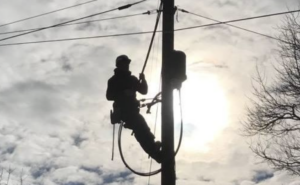 State laws capping telecommunication right-of-way fees — fees that deliver tens of millions of dollars annually to Texas cities and counties — violate the Texas Constitution, an attorney for a coalition of 59 cities has argued before the Texas Supreme Court.
Attorney C. Robert Heath also told the court that cities have clear “standing” to bring their case against the state — despite claims to the contrary from the Texas Attorney General’s office.
Legal Issues
These legal issues and others were considered by the Texas Supreme Court on March 5, during a much-anticipated oral arguments hearing relating to two state laws adopted in 2017 and 2019. Both laws limit how much cities can charge telecom providers for the use of public rights of way. The first, SB 1004, allows cities to charge no more than $250 per year for each network node installed in rights of way. The second, SB 1152, requires cities to assess only a single fee for companies that provide both telecommunications and cable services.
Cities have argued the laws violate the Texas Constitution’s “Gifts Clause” barring governments from awarding anything of value to private companies without due consideration of public benefit. Cities further argue that the laws have harmed them by draining away money that otherwise could go to important public services.
The state, meanwhile, argues that public rights-of-way ultimately are state property and so the capped fees cannot constitute an unconstitutional gift from cities.
Questions from the Court
The case, State v. City of McAllen et al., was brought before the high court at the state’s request after both a trial court and the Austin-based Third Court of Appeals ruled the laws unconstitutional. The state was represented in the March 5 hearing by Texas Solicitor General William Peterson. The representative for cities was Heath, of the Bickerstaff, Heath, Delgado, Acosta law firm.
In his oral arguments questioning, Justice Evan A. Young seemed to agree with cities that — regardless of the underlying merits of their case — that the state of Texas was an appropriate target for the litigation. “The cities have a legal obligation to implement these laws and a declaration that these two statutes are unconstitutional would surely redress the injury,” he said. But Solicitor General Peterson pushed back, stating that cities could have sued the network providers themselves. “There’s a real and concrete dispute here — and that’s between the cities and the network providers,” he said.
Justice Young also noted that the U.S. Supreme Court has ruled that states have special rights relating to standing. Young asked whether that precedent likewise applies to local governments in this case.
Peterson replied no, arguing that municipalities derive their authority from the state. Heath noted that the Texas Supreme Court’s own precedent holds that if a governmental subdivision is required to implement an unconstitutional law, then that subdivision has clear standing to raise the issue.
Justice Brett Busby asked Heath to clarify what sort of conveyance should be considered a “gift.” Busby noted, for instance, that rights-of-way were gifted for railroads during the 1800s. Heath replied that the transaction must be non-gratuitous and serve a predominant public purpose to avoid violating the gift clause. Peterson said the gifts clause was not relevant because the cities weren’t transferring public funds, just granting access to property that’s owned by the state.
Windfalls for Service Providers
Implementation of HB 1004 and SB 1152 created a windfall of more than $45 million for service providers across the state, the City of Houston told the court in a separate brief. Meanwhile, the laws cost Houston between $17 million and $27 million the first year after they were enacted, according to the city.
The case is State v. City of McAllen, Tex., No. 24-1060.